
Schrift ART Festival 2026
Litterae Ignotae – The Alphabet of Hildegard of Bingen
Many people are familiar with Hildegard of Bingen—but few know that she invented her own alphabet.
Why did she create this alphabet? What was it used for? Many of these questions remain unanswered—which only makes the whole thing even more mysterious. There has been much speculation. Personally, I agree with a widely held scholarly view: Hildegard used the alphabet to assert herself as an authority in the male-dominated world of the Middle Ages.
As a woman, it was dangerous to publicly express her own opinions, to preach, or to get involved. But with an alphabet revealed by God, she could say: I may be a woman, and my Latin may not be as elegant as that of the male church scholars—but look: I have my own script. I’m fascinated by this form of self-empowerment. Hildegard was a politically astute woman who knew how to present herself and her message in a compelling way. Her Litterae Ignotae were part of that.
I also regularly offer workshops and demonstrations on Hildegard’s alphabet—with a brief introduction to its historical and cultural context and plenty of time for participants to try it out and decipher it.
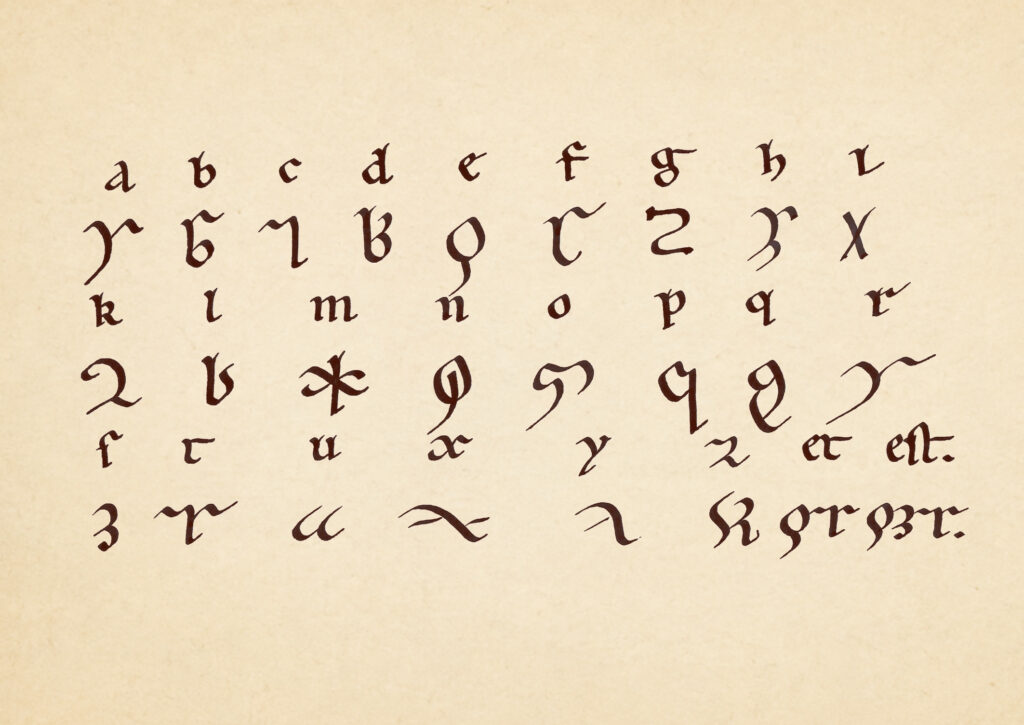
Litterae Ignotae – A Modern Interpretation
The medieval original undoubtedly has a mysterious charm. But after spending some time studying the letters, I felt a growing desire to develop a modern version as well: a consistent typeface that allows for design and experimentation.
This version can be written with a broad-nib pen or simply with a pencil—for example, for taking notes. It was important to me that the letters be clearly distinguishable. In the original, many characters closely resemble one another and are easily confused.
My revision respects the historical model but improves legibility and clarity. The new layout and design are based on what Hildegard von Bingen herself could have read—and might even have enjoyed using.


Scripture Circles – Scivias
I wanted to delve into the texts from the Scivias, Hildegard’s first and probably also her most famous theological work. Engaging with the original Latin text word for word was an enriching experience. Copying the same text over and over again brings a special familiarity to unfamiliar content. This process reminds me of working in a scriptorium. I do not adhere to any religion, yet I am fascinated by the idea of writing my way into this strange, slightly bewildering world of angels and visions and immersing myself in it meditatively.
At the center is writing in circles: circular motion, repetition, endlessness. The Rupertsberg Codex contains an illuminated manuscript depicting Hildegard’s vision of angelic choirs—it became a central starting point for my writing.
I also wanted to write her texts in a script inspired by the Riesenkodex —a mixture of Carolingian minuscule and early Gothic forms, the script of Hildegard’s time.
Scivias means “Know the Ways.” To know them, one must first find them. Writing, cutting up, and rearranging—that was my search for the way. The result is a series of text collages in which multiple circles are reassembled..


Daedalus – Written Labyrinths
If one wants to create a labyrinth with writing, what could be more natural than choosing a text that deals with the labyrinth itself? The starting point for Daedalus I and Daedalus II is Ovid’s Metamorphoses, specifically the passage about Daedalus, the archetypal architect who built the labyrinth on Crete: Daedalus ingenio fabrae celeberrimus artis ponit opus turbatque notas …—“Daedalus, most famous for his craftsmanship, creates the work and confuses the signs…”
In the search for a monumental script, a unicase alphabet was created whose formal language is inspired by the meander friezes of ancient Greek temples and which emerged from an earlier exploration of the uncial forms of Wulfila’s Gothic Bible.
Through layering and collage, the text becomes a labyrinth. The circular form is central here: it has no clear beginning and no end, but leads the gaze endlessly back into itself. Thus, the eye finds no exit.
The text is not primarily meant to be read. One is supposed to lose oneself in it—or, more precisely, to get lost in it. What is initially text becomes space; what appears legible becomes a path structure. I am interested in the moment when writing transcends its function as a vehicle for language and becomes something spatial, even architectural.


